
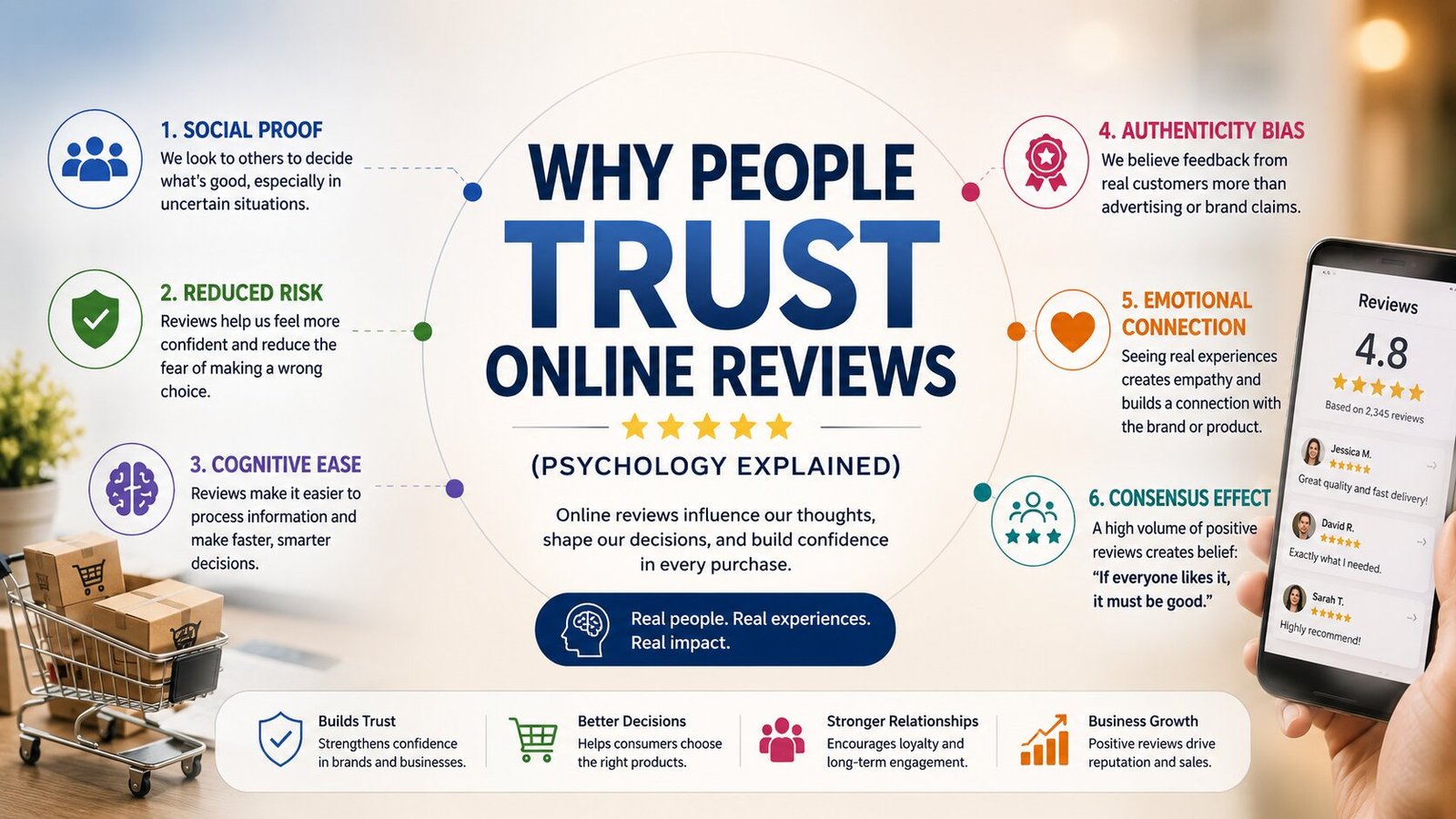
People Trust Online Reviews because reviews turn uncertainty into social evidence. Before choosing a business service, buying home and garden products, purchasing sports gear, exploring hobbies and crafts supplies, comparing electronics and technology, or ordering food, beverages, and tobacco products, consumers want reassurance that other people have already tested the experience. In a digital marketplace where customers cannot always see a product, meet the seller, or inspect the service in person, online reviews become practical trust signals.
The Psychology of Online Reviews is rooted in consumer psychology, social proof, emotional connection, and the human need to reduce risk. Customers read review ratings, star ratings, customer feedback, and customer opinions because these signals help them make purchase decisions with more confidence.
People naturally Trust Online Reviews because they provide real experiences from other consumers, helping reduce uncertainty and build confidence before making a buying decision. A strong online reputation, authentic reviews, verified reviews, and transparent review platforms can shape customer perception long before a person contacts a company or completes a purchase. Businesses that consistently generate genuine feedback are more likely to earn customer trust, strengthen credibility, and improve conversions. Consumers also Trust Online Reviews when they see detailed experiences, balanced opinions, and consistent ratings across multiple platforms. In today’s digital marketplace, brands that encourage transparency and maintain positive customer experiences are far more likely to Trust Online Reviews as a powerful tool for long-term reputation growth and customer loyalty.
The Psychology Behind Online Review Trust
Online reviews work because people are naturally influenced by the experiences of others. In consumer psychology, this is closely tied to the decision-making process. When customers face too many options, they use mental shortcuts to decide which brand, product, or provider feels safe. Review credibility, online credibility, and customer trust become especially important when the buyer has limited prior experience with a company.
The reason people Trust Online Reviews is not only that reviews provide information. It is that reviews provide human context. A product description may explain features, but customer reviews influence decisions by describing real use, service quality, delivery experiences, customer interaction, and whether expectations were met.
Social Proof and Social Validation
Social proof means people look to the behavior and opinions of others when deciding what to believe or do. If many customers leave positive reviews about a trustworthy business, new shoppers are more likely to assume that the business can deliver a good customer experience. Social validation is powerful because it tells the brain, “Other people have chosen this and were satisfied.”
This is why review ratings and star ratings carry emotional weight. A high rating does not simply communicate quality; it suggests community approval. When consumers see consistent customer satisfaction across a large number of online reviews, they feel that choosing the business is less risky.
Reducing Risk in Buying Decisions
Every purchase includes some level of risk. The risk may involve money, time, convenience, safety, or disappointment. People often Trust Online Reviews because they reduce uncertainty and provide real-world experiences that help consumers feel more secure before making a decision. Online reviews reduce that risk by giving consumers details they may not find in advertising.
A person deciding between two service providers may look for authentic reviews that mention punctuality, communication, pricing, or follow-through. Customers also Trust Online Reviews when they see honest feedback describing both strengths and weaknesses, as this creates a stronger sense of transparency and credibility. In competitive industries, businesses that consistently generate detailed customer feedback are more likely to build long-term trust, improve reputation, and encourage buyers to Trust Online Reviews as part of their decision-making process.
Negative reviews also play a role in risk assessment. Although businesses often prefer only positive reviews, a balanced review profile can feel more believable. Customers understand that no business is perfect. When negative reviews are specific, and the company responds with a thoughtful review response strategy, consumers may actually gain confidence in the business reputation.
Why Social Proof Shapes Customer Behavior
Social proof influences consumer behaviour because people tend to trust patterns. A single review may be helpful, but a pattern of customer feedback across review platforms creates stronger consumer trust signals. This is one of the main reasons people Trust Online Reviews, especially when they consistently reflect positive customer experiences over time.
This is why online reputation management is not just about collecting more reviews; it is about building a reliable pattern of public perception. Consumers are more likely to Trust Online Reviews when they notice recurring themes such as professionalism, quality service, fast communication, and customer satisfaction across multiple platforms. Businesses that maintain consistency in customer feedback, transparency, and engagement are more likely to strengthen credibility and encourage future buyers to Trust Online Reviews before making purchasing decisions.
Online recommendations also function like digital word-of-mouth marketing. Traditional word of mouth came from friends, relatives, and neighbors. Today, electronic word of mouth (eWOM) allows strangers to influence buying decisions at scale. A customer in one city can help another customer understand whether a business is credible, responsive, and worth choosing.
Electronic Word of Mouth (eWOM)
Electronic Word of Mouth (eWOM) includes online reviews, social media comments, testimonials, review summaries, and user-generated content. It matters because people often view peer experiences as more objective than brand messaging. A company may describe itself as reliable, but customers want proof from people who already completed the customer journey.
For example, a home and garden customer may trust a review showing before-and-after results. A sports shopper may rely on comments about product durability. A hobbies and crafts buyer may want feedback about material quality. An electronics and technology customer may look for support and warranty experiences. A food, beverages, and tobacco customer may evaluate freshness, packaging, and delivery reliability.
Customer Reviews Influence Perception
Customer reviews influence brand perception by shaping expectations before the first interaction. If customers repeatedly praise a company’s communication, speed, and professionalism, new buyers expect a similar experience. If reviews mention delays, poor support, or confusing policies, customers may approach the brand with hesitation.
This influence affects customer perception, customer expectations, and customer confidence. Review influence can even determine whether a person clicks a website, calls a company, or leaves the search page entirely. In this way, online reviews do not simply reflect reputation; they actively create it.
Authenticity Makes Reviews More Persuasive
People trust reviews most when they feel authentic. Review authenticity depends on detail, balance, transparency, and relevance. Reviews that explain what happened, why it mattered, and how the business handled the situation are more persuasive than vague comments. Authentic reviews also tend to include specific customer emotions, practical observations, and realistic language.
Verified reviews strengthen digital trust because they indicate that the reviewer likely had a real transaction or experience. Although verification systems are not perfect, they can improve review credibility and reduce suspicion. Review transparency helps consumers understand how reviews are collected, displayed, and moderated.
Authentic Reviews and Verified Reviews
Authentic reviews feel credible because they include natural detail. They may mention the product ordered, the service appointment, the staff interaction, or the outcome. Verified reviews add another layer of confidence because they are connected to a confirmed purchase, booking, or customer interaction.
Customers often compare authentic reviews with overly polished or generic feedback. If every review sounds identical, consumer skepticism may increase. If reviews vary in tone, detail, and perspective, the business may appear more trustworthy because the feedback feels like real user-generated content.
Review Transparency and Credibility
Review transparency means customers can see how review platforms manage feedback. Transparent platforms make it easier to identify verified reviews, understand review ratings, and evaluate whether review summaries are fair. Review credibility improves when customers believe reviews are not hidden, edited unfairly, or manipulated.
A transparent review environment supports consumer confidence. It also helps businesses build trust in a sustainable way. Instead of relying on artificial praise, a business can use honest customer feedback to improve service quality, strengthen customer engagement, and refine its reputation strategy.
The Emotional Side of Customer Trust
The psychology of online reviews is not purely rational. Customers are emotional decision-makers, especially when purchases involve personal needs, family priorities, financial concerns, or identity. A review that describes relief, satisfaction, frustration, or loyalty can create an emotional connection that facts alone may not provide.
Customer emotions influence trust factors because people imagine themselves in the reviewer’s situation. If a reviewer says a company solved a stressful problem quickly, potential customers may feel reassured. If several reviewers describe feeling ignored, new customers may worry that they will have the same experience.
Emotional Connection and Customer Experience
Emotional connection develops when reviews describe the human side of a transaction. A customer may praise a support representative who listened carefully, a technician who arrived on time, or a seller who resolved a problem without blame. These details make the customer experience more vivid and believable.
Strong emotional signals can also build brand trust. Customers do not only ask, “Is this product good?” They ask, “Will this company treat me well if something goes wrong?” Reviews that answer this question help turn hesitation into trust.
Customer satisfaction and loyalty are central to long-term trust. Customer satisfaction is one of the strongest drivers of positive reviews. When people feel that a business met or exceeded expectations, they are more likely to leave public feedback. Over time, this feedback contributes to customer loyalty, reputation building, and a stronger online brand image.
Loyal customers may also defend a brand, recommend it to others, and contribute to word-of-mouth marketing. Their online reviews become part of a broader reputation strategy, helping the business attract new customers through trust-based marketing rather than direct promotion alone.
How Review Signals Affect Business Reputation
Review signals influence business reputation because they are visible, searchable, and often compared across competitors. A company’s online presence may include review platforms, social media pages, search results, directory listings, and a Trust Score. Together, these elements shape whether people see the business as reliable, professional, and transparent.
Online reputation management is the process of monitoring, responding to, and learning from reviews. It includes review management, customer engagement, review response strategy, and reputation building. Businesses that treat reviews as customer intelligence, rather than simply public praise or criticism, can improve both operations and public perception.
Review management and response strategy support a better user experience. Review management involves tracking online reviews, analyzing customer feedback, and responding professionally. A good review response strategy acknowledges customer opinions, thanks satisfied customers, and addresses negative reviews with accountability. This matters because potential buyers often read company responses as carefully as the original review.
A respectful response can show service quality, transparency, and emotional maturity. Even when a review is negative, a calm and helpful reply can strengthen digital trust. Customers want to know that if they have a problem, the business will listen and respond.
Why Online Reviews Influence Purchase Decisions
Online reviews influence purchase decisions because they combine information, emotion, and social validation. Customers use reviews to evaluate quality, compare alternatives, estimate risk, and predict their own experience. This is why customer reviews influence is so strong across industries and price points.
A person may begin with a simple search, then scan star ratings, read review summaries, compare positive reviews and negative reviews, evaluate review credibility, and look for trust signals. This process may happen quickly, but psychologically it gives the consumer a sense of control. The more credible the reviews appear, the easier it becomes to make a buying decision.
Review Platforms, Star Ratings, and Trust Score
Review platforms organize customer feedback into visible signals such as star ratings, review ratings, review summaries, and a Trust Score. These signals help consumers process a large amount of information quickly. A strong score may encourage a shopper to continue researching, while a weak pattern may push them toward another provider.
However, customers rarely rely on one number alone. They often compare the rating with review volume, review authenticity, verified reviews, and recent customer experience. A high rating supported by detailed authentic reviews is more persuasive than a perfect rating with very little context.
Building a trustworthy business through reviews requires understanding consumer influence. A trustworthy business uses reviews as part of continuous improvement. It invites honest customer feedback, responds to concerns, protects review transparency, and improves service quality based on recurring themes. This approach strengthens online reputation, brand trust, customer engagement, and consumer confidence.
People Trust Online Reviews because they reflect real experiences, emotional stories, and social proof. When reviews are authentic, transparent, and supported by consistent customer satisfaction, they become powerful consumer trust signals. For businesses, the lesson is clear: the strongest online credibility comes not from claiming trust, but from earning it through every customer interaction.
