
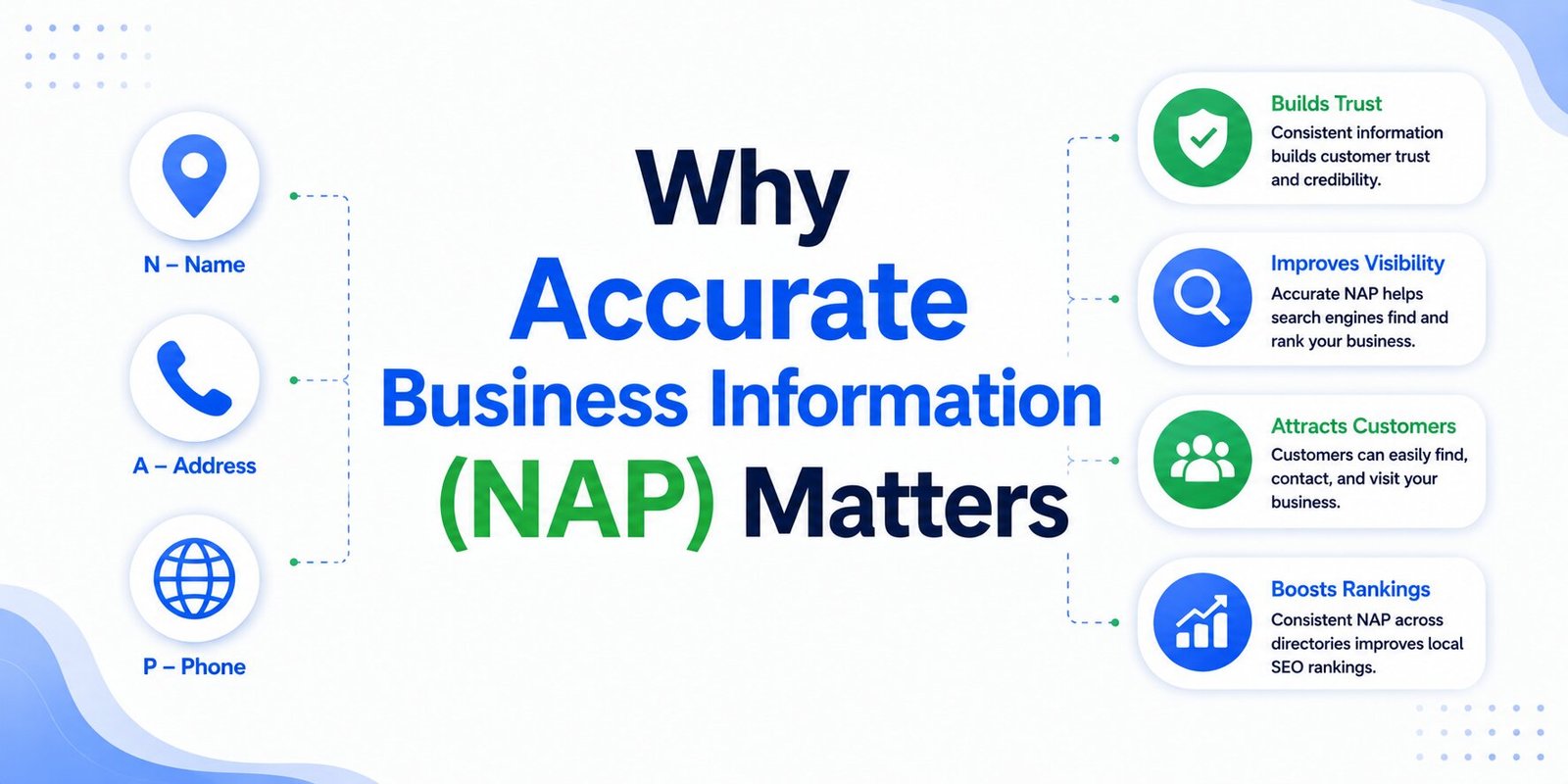
Business Information is one of the most important foundations of local search performance, customer confidence, and digital credibility. When people look for a company online, they expect the basic details to be correct immediately. If the business name, address, phone number, hours, or website are wrong, the customer may lose trust before the first conversation begins.
In local marketing, this information is often discussed as Name Address Phone Number, or NAP. Strong NAP Data Accuracy means that a business presents the same core identity across Google, maps, directories, websites, and citation platforms. Whether a company provides a business service, sells home and garden products, supports sports programs, offers hobbies and crafts supplies, specializes in electronics and technology, or operates in food, beverages, and tobacco, accurate NAP details help customers find, contact, and choose the business with confidence.
Business Information Is the Foundation of Local Search
Accurate Business Information supports both human users and search engines. Customers use it to decide whether a company is close enough, open now, and easy to contact. Search engines use it to understand where the business is located, what it is called, and whether it appears trustworthy enough to show in local results.
This makes NAP more than a technical SEO detail. It is an SEO Foundation that affects Customer Experience, Business Credibility, Search Engine Trust, and Online Visibility. A business with complete and consistent contact details is easier for customers to verify and easier for search platforms to interpret.
NAP Data Accuracy means that the business name, address, and phone number are correct, current, and formatted clearly. It includes details such as suite numbers, local phone numbers, official business names, and service-area information. If a company moves, changes its phone line, rebrands, or opens a second location, the NAP information must be updated quickly.
NAP Consistency means that the same details appear across all major digital platforms. When a company’s website shows one address, a directory shows another, and a map profile lists an old phone number, search engines may see conflicting signals. Customers may also become frustrated. Consistency creates a stronger sense of reliability and helps support Consistent Business Information across the web.
The phrase Name Address Phone Number may sound simple, but it represents the core identity of a local business. The business name should match signage, invoices, website branding, social profiles, and directory profiles. Business Name Consistency is especially important for companies that use abbreviations, franchise names, or multiple service brands.
Business Contact Consistency also includes an Accurate Phone Number, Address Accuracy, and correct website or email details where they appear. If a customer calls a disconnected number or drives to the wrong location, the business loses more than a lead. It loses trust, which can affect future reviews, referrals, and Online Reputation.
How NAP Accuracy Impacts Local SEO
Local SEO depends on clear location data and trustworthy business signals. Search engines want to provide users with relevant, nearby, and reliable results. If a business has conflicting contact details, search platforms may struggle to confirm which information is correct. This can reduce the business’s ability to compete in Local Search Results, map results, and directory-based discovery.
For Local Business SEO, accurate NAP details help search engines connect a company to the right geographic area. This supports Geographic Relevance, Location-Based SEO, Local Business Authority, and Local Search Presence. The more reliable the information appears, the stronger the business’s foundation for local visibility becomes.
Local SEO and Local Business SEO
Local SEO focuses on improving visibility for searches that include local intent, such as city-based searches, neighborhood searches, service-area searches, and “nearby” queries. Local Business SEO is especially important for storefronts, clinics, contractors, restaurants, retailers, and service providers that depend on nearby customers and a High-Converting Business Profile to attract local leads and build customer trust.
Accurate NAP data helps search engines match a business with the right area. A home and garden supplier, sports equipment shop, craft studio, electronics repair company, or food, beverages, and tobacco retailer all need location signals that match customer intent. Without accurate business information, even a strong website may struggle to appear for relevant local searches.
Local Search Rankings and Local Ranking Factors
Local Search Rankings are influenced by many Local Ranking Factors, including relevance, distance, prominence, reviews, website quality, links, and citations. NAP accuracy supports several of these factors because it helps search engines confirm where the business operates and whether other sources agree with its details.
Accurate contact details also support Google Maps Rankings and Local Pack Rankings. The local pack is highly competitive because it appears prominently in search results and often includes a map, ratings, directions, and call buttons. While NAP consistency alone does not guarantee ranking, it supports the trust signals search engines rely on when comparing local businesses.
Business Listings, Citations, and Directory Accuracy
Business Listings and Local Citations are references to a company’s core details on external websites. These may appear on search platforms, review sites, social networks, chamber of commerce pages, industry directories, mapping apps, and Business Directories. Each citation gives search engines another opportunity to confirm the business’s identity.
However, citations only help when they are accurate. Wrong information can spread through Data Aggregators, old directory feeds, third-party platforms, and automated listing systems. This is why Citation Management, Listing Management, and Local Listings Management are essential parts of a strong local marketing strategy.
Business Listings, Local Citations, and Online Directory Listings
Business Listings usually include a business name, address, phone number, website, description, category, hours, images, and customer reviews. Local Citations may include full NAP details or partial references to the business. Online Directory Listings can appear on broad directories, niche platforms, regional business sites, or industry-specific resources.
For SEO, citations function as confirmation signals. If many trustworthy sources show the same information, search engines have more confidence in the business. This strengthens SEO Trust Signals, Trustworthy Listings, and Local Business Visibility. For customers, it also creates a smoother discovery process because the details remain the same wherever they search.
Duplicate Listings, Data Aggregators, and Listing Synchronization
Duplicate Listings can confuse both customers and search engines. They may appear when a business changes address, rebrands, has multiple departments, or is added automatically by different platforms. One listing may show old hours, another may show a wrong phone number, and another may have outdated photos or reviews.
Data Aggregators collect and distribute business data to many platforms. If their records contain outdated details, errors can multiply quickly. Listing Synchronization helps prevent this by aligning information across search engines, directories, maps, and citation networks. Businesses should monitor listings regularly to keep the public record accurate.
Optimizing Google Business Profile and Structured Data
A Google Business Profile is one of the most visible places where customers encounter local businesses. It can appear in Google Search, Google Maps, and the local pack. Because of its visibility, Google Business Profile Optimization is critical for companies that want stronger Business Discovery, Search Visibility, and customer engagement.
Optimization means more than filling in a profile once. It involves accurate NAP details, correct categories, updated hours, complete services, quality photos, review responses, and business verification. When this profile aligns with the website and other citations, it supports both customer trust and search engine confidence.
Google Business Profile and Google Business Profile Optimization
A complete Google Business Profile should include the official business name, accurate address or service area, current phone number, website link, hours, categories, services, attributes, images, and review management. This information helps customers determine whether the business is relevant before they visit or call.
Google Business Profile Optimization also supports Google Maps SEO because map visibility depends heavily on accurate location and category data. For a service-area business, the profile should clearly define where the company operates without misleading customers. For a storefront, the address and hours must be precise so customers can visit successfully.
Structured Data and Local Business Schema
Structured Data helps search engines understand the content on a website. Local Business Schema is a type of structured data that can describe a company’s name, address, phone number, hours, website, location, and other relevant details. When implemented correctly, it reinforces the business information that appears on the website.
Structured data should match the visible information on the page and the details used in external citations. If schema markup lists one phone number while the website footer lists another, the inconsistency may weaken clarity. Good structured data supports Business Information Accuracy and helps search engines connect the website to the correct local entity.
Tools, Audits, and Citation Management
Maintaining NAP accuracy manually can be difficult, especially for businesses with multiple locations or listings across many directories. This is where Citation Tools and audit processes become useful. Tools can help identify inconsistent listings, duplicate profiles, missing citations, and incorrect phone or address data.
Common tools used in citation and local SEO work include BrightLocal, Moz Local, Yext, Whitespark, Semrush, and Ahrefs. Each platform has different strengths. Some focus on citation tracking, some help with distribution, and others support broader SEO analysis, backlink monitoring, rank tracking, or competitive research.
Citation Tools: BrightLocal, Moz Local, Yext, and Whitespark
BrightLocal is often used for citation audits, local rank tracking, and reputation monitoring. Moz Local helps businesses manage listing consistency across major platforms. Yext focuses on broad listing distribution and real-time updates across partner networks. Whitespark is well known for citation discovery and local search research.
These tools can support Citation Building, Citation Audit, and ongoing Citation Management. They are especially useful for companies that need to clean up old records, track competitor citations, or improve local search presence. However, tools still require accurate source information. A platform can distribute data efficiently, but the business must provide the correct details first.
Semrush, Ahrefs, and NAP Audit Workflows
Semrush and Ahrefs are commonly associated with broader SEO, but they can still support local strategy through site audits, backlink research, keyword analysis, and visibility tracking. When combined with citation-specific tools, they can help businesses understand how NAP accuracy fits into the larger search ecosystem.
A strong NAP Audit should identify incorrect listings, duplicates, missing citations, inconsistent names, outdated phone numbers, wrong addresses, and mismatched website links. For Multi-Location SEO, each location should have its own accurate profile, location page, phone number when appropriate, and consistent directory data. This prevents one location’s information from interfering with another’s visibility.
Building Trust Through Accurate Local Listings
Accurate NAP information directly affects Customer Trust. When people find the same details across Google, directories, social media, and the company website, they are more likely to believe the business is active and reliable. In contrast, conflicting information creates uncertainty and can make a company appear careless.
Accuracy also supports Business Verification, Local Search Optimization, and long-term Local Marketing Strategy. Verified and consistent listings give platforms more confidence in the business, while customers receive a better experience from discovery to contact. This matters in every industry, from professional services to home and garden, sports, hobbies and crafts, electronics and technology, and food, beverages, and tobacco.
Businesses should treat NAP maintenance as an ongoing responsibility rather than a one-time setup task. Any change to business name, address, phone number, website, operating hours, service areas, ownership, or branding should trigger a full review of listings. This review should include the website, Google Business Profile, major directories, social channels, data aggregators, and industry-specific platforms.
A reliable local presence also requires reputation awareness. Online Reputation is shaped by reviews, ratings, responses, and the accuracy of public information. If customers leave negative feedback because they called the wrong number or arrived at a closed location, the original problem may have been a simple listing error. Preventing these issues protects both reputation and revenue.
Ultimately, accurate Business Information is essential because it connects search visibility with customer confidence. Strong NAP consistency supports local SEO citations, business discovery, search engine algorithms, local search results, Google Maps rankings, and local pack rankings. It also improves customer experience by making the business easier to find and contact. When companies invest in citation management, listing synchronization, structured data, Google Business Profile optimization, and regular audits, they build a stronger local search presence and a more trustworthy online identity.
