
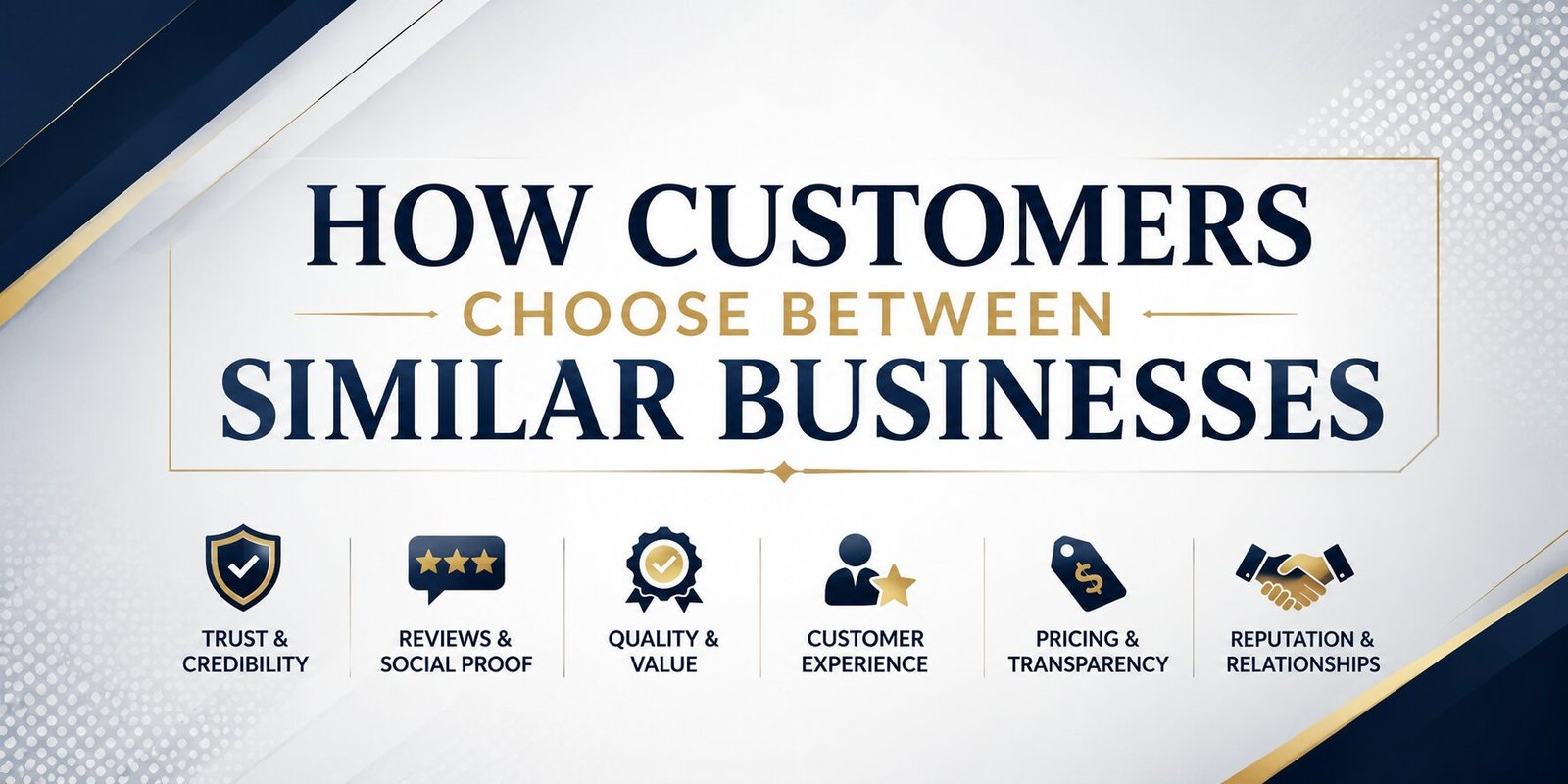
When customers compare Similar Businesses, they rarely make a decision based on one feature alone. Price matters, but customer decision-making is also shaped by customer trust, business credibility, customer experience, brand perception, online reputation, and the feeling that one company is safer or easier to work with than another. A person choosing a business service, a home and garden contractor, sports gear, hobbies and crafts supplies, electronics and technology products, or food, beverages, and tobacco retailers is often looking for reassurance as much as information.
The modern customer has more choices than ever. Search engines, Google reviews, online reviews, social proof, websites, and social media make it simple to compare multiple options in minutes. Because of this, buying decisions are influenced by both facts and emotions. Understanding how customers compare Similar Businesses is essential for brands that want to build trust and stand out in competitive markets.
Customers want value, but they also want a reliable business that communicates clearly, looks professional, and provides proof that other people have had positive experiences. When comparing Similar Businesses, customers often look at reputation, reviews, customer experience, and overall credibility before making a final decision. Businesses that understand why customers choose Similar Businesses can improve customer trust, strengthen brand authority, and create stronger conversion rates.
Why Customers Compare Similar Businesses Carefully
Customers compare Similar Businesses carefully because the difference between providers is not always obvious at first glance. Two companies may offer similar services, similar products, or similar prices, but customers still need to decide which one feels more trustworthy. This is where consumer behaviour, purchase psychology, business reputation, and first impressions become important.
In many cases, the customer’s decision begins with a practical need. Someone may need lawn care, a sporting goods supplier, a craft store, a computer repair company, or a specialty food retailer. However, the final decision usually depends on confidence. When customers compare Similar Businesses, they often focus on trust, reputation, and overall professionalism rather than price alone.
Customers ask themselves whether the business looks established, whether the website is credible, whether reviews seem authentic, and whether the brand appears consistent across different channels. Similar Businesses that maintain strong branding, clear communication, and positive customer feedback are far more likely to earn customer trust and influence buying decisions.
Customer decision-making and purchase psychology
Customer decision-making is a blend of rational evaluation and emotional reassurance. Rational factors include price, availability, services, location, operating hours, and website optimization. Emotional factors include customer trust, brand reliability, customer satisfaction, and the belief that the company will deliver what it promises. Purchase psychology shows that customers often choose the option that reduces uncertainty fastest.
This matters because Similar Businesses often compete in crowded markets. If two providers offer comparable services, the one with clearer brand messaging, stronger customer feedback, and a better digital presence may win the customer. A business does not always need to be the cheapest; it needs to feel credible, relevant, and dependable.
Consumer behaviour and buyer intent
Consumer behaviour changes depending on what the customer needs and how urgent the situation is. When comparing Similar Businesses, customers with immediate buyer intent often choose the company with the strongest local SEO presence, accurate contact details, and a fully optimized Google Business Profile. Quick trust signals can heavily influence fast buying decisions.
A customer doing deeper research may compare customer testimonials, website authority, verified reviews, and overall online reputation before taking action. Similar Businesses that demonstrate credibility, professionalism, and consistent branding across multiple platforms are more likely to build trust and convert potential customers into loyal clients.
Different industries also create different expectations. Home and garden customers often want visual proof, reliability, and transparent communication. Sports buyers may focus on performance, product knowledge, and customer satisfaction. Hobbies and crafts shoppers may value variety and helpful guidance. Electronics and technology customers often look for expertise and support, while food, beverages, and tobacco buyers may care about freshness, compliance, convenience, and brand trust.
Trust Signals That Influence the Final Choice
Trust signals are the clues customers use to decide whether a company deserves their attention. These signals include Google reviews, verified reviews, customer testimonials, business transparency, professional appearance, brand consistency, and clear contact information. When customers compare Similar Businesses, strong trust signals often become the deciding factor behind a purchase or inquiry.
People naturally gravitate toward Similar Businesses that appear reliable, established, and consistent across all platforms. Trust-building elements can be the reason one company receives the call, booking, or purchase while another business is ignored, even when both offer similar products or services.
Customer trust is built through repeated signs of reliability. A business with accurate details, helpful content, recent online reviews, active customer engagement, and consistent messaging appears safer than one with missing information or an outdated digital presence. Trust online Reviews, testimonials, and public customer feedback often act as digital word-of-mouth, helping customers feel that they are making a lower-risk decision.
Google reviews, verified reviews, and social proof
Google reviews are often one of the first trust signals customers notice. A strong review profile with recent feedback, balanced comments, and thoughtful business responses can improve consumer confidence. Verified reviews add another layer of reassurance because customers see them as more connected to real customer experiences.
Social proof works because people are influenced by patterns. If many customers describe a positive customer experience, new buyers are more likely to believe the business can deliver similar results. Online reviews, customer testimonials, and visible customer satisfaction help create consumer trust, especially when customers are uncertain or comparing several providers.
Business reputation and online reputation management
Business reputation is the public perception customers form before they contact a company. Online reputation management helps shape that perception through review monitoring, professional responses, customer engagement, and a consistent reputation strategy. A business that responds respectfully to both positive and negative reviews appears more accountable and trustworthy.
Negative feedback does not always prevent buying decisions. Customers understand that no business is perfect. What matters is whether the company responds with transparency, responsibility, and a willingness to improve. Strong reputation management can turn a difficult review into proof of business credibility.
Brand Perception and Differentiation
Brand perception shapes how customers interpret everything they see. A company may provide excellent service, but if its website is confusing, its images look outdated, or its messaging is inconsistent, customers may question its quality. Professional appearance, authentic branding, and brand consistency help customers believe that the company pays attention to detail.
Business differentiation is the process of making one company feel distinct from competitors. For Similar Businesses, differentiation does not always depend on a unique product. It can come from a stronger value proposition, clearer communication, more helpful content, better customer service, or a more trustworthy online presence. These elements create a competitive advantage by making the business easier to understand and easier to choose.
Value proposition and brand positioning
A value proposition explains why customers should choose one business over another. It should connect the customer’s problem with the company’s strongest benefit. A business might emphasize faster service, specialized knowledge, transparent pricing, premium materials, local expertise, or better support. The more clearly this value is communicated, the easier it becomes for customers to compare options.
Brand positioning gives that value proposition a memorable place in the customer’s mind. If a company wants to build brand authority, it should communicate consistently across its website, Google Business Profile, social media, advertising, and online reviews. Brand awareness grows when customers repeatedly see the same message and understand what the company stands for.
Authentic branding and emotional connection
Authentic branding helps customers feel that a business is real, human, and dependable. Customers are more likely to trust companies that explain their process, show real people, use clear language, and avoid exaggerated promises. Authentic branding supports emotional connection because customers want to feel understood rather than pressured.
This emotional connection can be decisive when customers compare Similar Businesses with similar prices and services. A brand that sounds helpful, confident, and transparent can feel more trustworthy than one that simply lists features. Over time, this can support customer loyalty, stronger client relationships, and a more favorable public perception.
Online Visibility and Search Influence
Online visibility affects which companies customers consider first. A business that does not appear in local search results, Google Maps, online directories, or organic search may never become part of the customer’s comparison. Search engine visibility, organic traffic, search rankings, and business discoverability all influence customer acquisition.
Local SEO is especially important for nearby services and location-based purchases. A complete Google Business Profile can help a business appear when customers search by category, need, or location. Search intent also matters because customers searching for “best,” “near me,” “open now,” or “trusted” may already be close to making a buying decision.
Local SEO, search rankings, and Google Business Profile
Local SEO helps businesses appear when customers are actively looking for nearby solutions. A complete Google Business Profile with accurate information, relevant categories, service details, photos, and Google reviews supports online visibility. Strong search rankings can also influence customer perception because many people assume visible businesses are more established or more reliable.
Website optimization reinforces search visibility. Fast pages, clear navigation, useful service content, and consistent business information improve user experience and website credibility. When local SEO and website quality work together, customers are more likely to move from discovery to action.
AI-driven search, search intent, and business discoverability increasingly shape customer choice. AI-driven search helps engines interpret what customers really want and summarize options based on relevance, authority, reputation, and useful information. This makes business discoverability more dependent on accurate content, strong website authority, and a reliable digital presence.
Businesses that want to attract customers should create content that answers real customer questions. Phrases such as how to attract customers, how businesses build trust, and why customers choose businesses reflect the concerns people search for before making decisions. Helpful content can improve online visibility, support customer acquisition, and increase trust before a customer makes contact.
Website Experience and Conversion Factors
After customers find a business, the website often becomes the next decision point. A website that loads quickly, explains services clearly, and makes contact easy can increase conversions. A confusing website can reduce trust even if the company has strong reviews. Customers expect easy navigation, clear answers, and a straightforward path to the next step.
Conversion optimization focuses on turning visitor interest into action. This may include clearer calls to action, better contact forms, stronger service pages, transparent pricing guidance, and persuasive customer testimonials. For Similar Businesses, small improvements in clarity and usability can produce meaningful gains in lead generation and conversion rates.
Website credibility and user experience shape how visitors interpret a company. Website credibility depends on professional design, accurate information, useful content, and visible trust signals. Customers evaluate layout, images, copy quality, page speed, mobile usability, and overall professionalism. They may not consciously analyze each element, but poor user experience can quickly create doubt.
A credible website supports the customer journey by answering questions in a logical order. It explains what the business offers, who it serves, why it is qualified, what customers can expect, and how to get started. This structure helps match buyer intent with a clear path forward.
Conversion optimization and lead generation
Conversion optimization helps businesses convert attention into inquiries, calls, bookings, or purchases. Strong lead generation depends on reducing friction. Customers should not have to search for contact details, guess what to do next, or wonder whether the business serves their location.
Companies can increase conversions by using action-oriented messaging, visible customer testimonials, proof of results, and simple contact options. When a customer already feels positive about the brand, an easy next step can be enough to turn interest into action. This is why website credibility, customer trust, and conversion optimization should work together.
How Businesses Stand Out From Competitors
To stand out from competitors, a company must combine trust, visibility, differentiation, and customer-focused branding. Customers compare Similar Businesses through reputation, convenience, brand authority, emotional connection, and perceived value. The winning company is often the one that removes uncertainty fastest.
A strong marketing strategy should focus on more than attention. It should improve online reputation, increase customer trust, build brand authority, and support lasting client relationships. The most effective brands understand that customer expectations begin before the first call, visit, or purchase. Every review, search result, website page, and message contributes to customer perception.
Customer-focused branding and transparent communication determine whether a company feels relevant and honest. Customer-focused branding begins with understanding what customers care about most. Instead of only describing the company, the brand should explain how it helps people solve problems, save time, reduce stress, or make better buying decisions. Transparent communication reinforces this by setting clear expectations about pricing, timelines, policies, availability, and service quality.
Transparency builds customer trust because it respects the decision-making process. Customers are more likely to choose a trustworthy business that explains details clearly than one that hides important information. Clear communication also improves business credibility because it shows confidence and professionalism.
Businesses that want stronger results should treat trust as a complete system. They should improve business credibility through consistent messaging, reliable service, visible proof, strong customer feedback, and brand reliability. Over time, these signals improve business reputation, strengthen customer loyalty, and support sustainable growth.
Ultimately, customers choose between Similar Businesses by asking which company feels most credible, relevant, and easy to trust. Price and features matter, but customer experience, online reviews, brand authority, search engine visibility, and business transparency often decide the final choice. Companies that invest in trust-building, online visibility, authentic branding, and a strong customer journey give buyers the confidence to choose them again and again.
