
In the modern digital economy, actively collecting customer feedback is only the first step in building a sustainable, customer-centric organization. Responding to Reviews effectively is what transforms customer opinions into trust, loyalty, and meaningful business improvements. Whether you operate a local business service, a regional home and garden supplier, a retailer specializing in sports or hobbies and crafts, a high-end electronics and technology outlet, or a distributor of food, beverages, and tobacco, a thoughtful approach to Responding to Reviews can significantly influence your reputation.
By making Responding to Reviews a consistent part of your customer experience strategy, you demonstrate that every customer’s voice is valued and taken seriously. While we have previously discussed How Quickly Should a Business Respond to a Review, speed is just one factor. Executing a flawless customer feedback strategy requires nuance and tact. Unfortunately, many companies fall into common traps that actively damage customer relationships rather than strengthening them. Understanding and avoiding these frequent customer feedback mistakes is absolutely critical for improving customer satisfaction, driving client retention, and ensuring long-term business improvement.
The Danger of Emotional and Defensive Responses
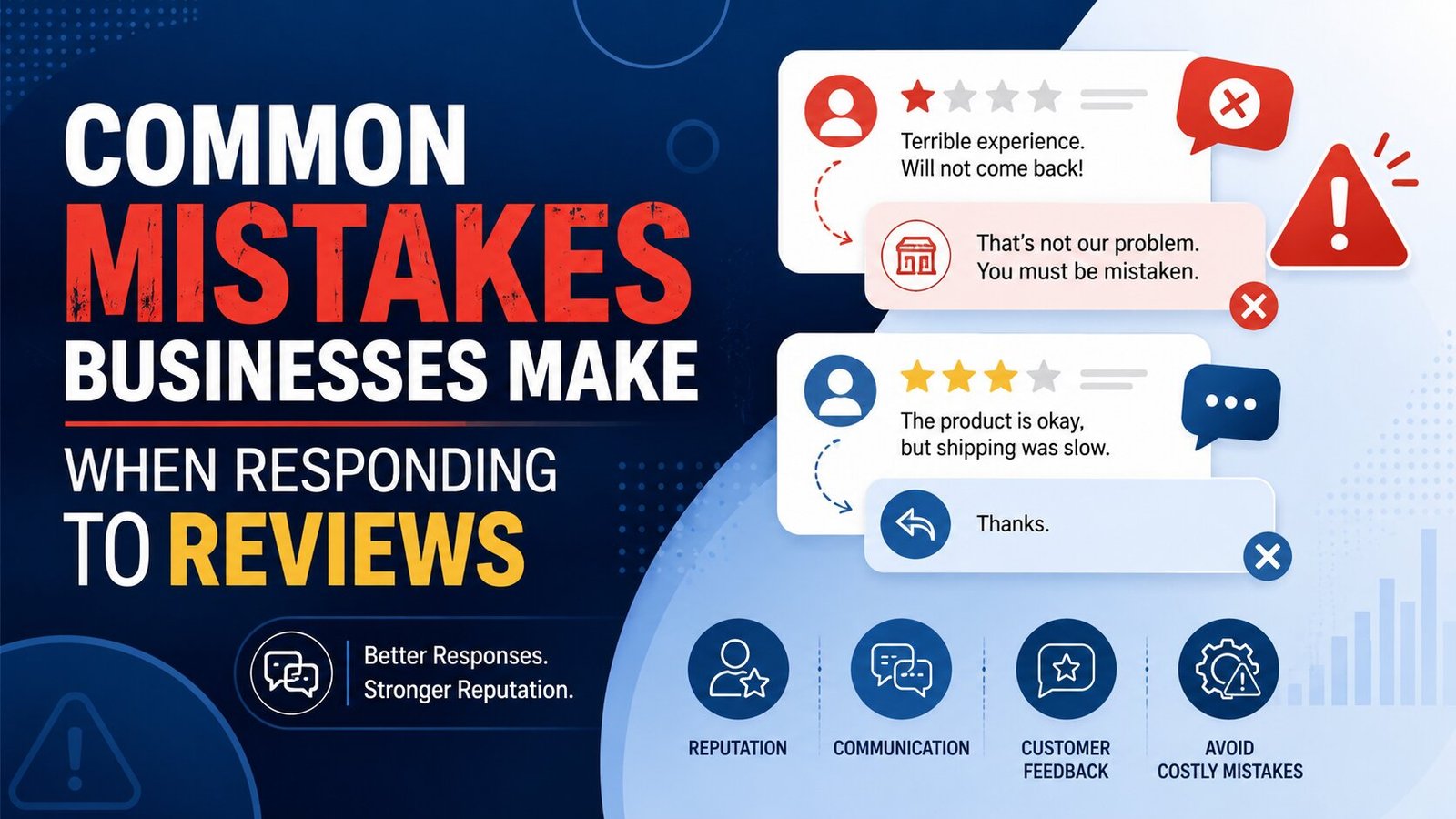
One of the most damaging mistakes a business can make when Responding to Reviews is allowing emotion to dictate the reply. When a business owner reads a harsh critique of their life’s work, the natural instinct may be to become defensive or fight back. However, Responding to Reviews with anger, sarcasm, or blame can quickly damage customer trust and harm the brand’s reputation. A professional approach to Responding to Reviews requires patience, empathy, and a clear focus on resolving the concern rather than winning the argument.
Ignoring Customer Perspectives and Getting Defensive
Ignoring customer perspectives in favor of defending the business is a serious mistake when Responding to Reviews. Hostile, sarcastic, or dismissive replies shift attention away from the customer experience and make the feedback entirely about protecting the company. This approach can alienate the original reviewer and show future customers that the business is unwilling to accept accountability. Effective Responding to Reviews requires a calm, empathetic tone that acknowledges the customer’s concerns without immediately admitting fault. By Responding to Reviews with professionalism and a genuine willingness to resolve the issue, businesses can de-escalate conflict while protecting customer trust and brand reputation.
Failing to Move the Conversation Offline
Another critical error is attempting to litigate complex customer complaints in a public forum. Engaging in a lengthy, public back-and-forth rarely ends well and often makes the business look petty. The goal of a public response to a negative review should be to briefly acknowledge the issue and immediately transition to direct customer feedback channels. Providing a phone number or email address to continue the conversation offline demonstrates a genuine commitment to resolving the issue privately and professionally.
Pitfalls in the Feedback Collection Process
The errors businesses make are not limited to how they type out their responses; significant mistakes frequently occur during the feedback collection process itself.
Relying Only on Hard Data and Ignoring Qualitative Feedback
A major strategic error is relying only on hard data while completely ignoring qualitative feedback. While quantitative feedback like star ratings and Net Promoter Scores (NPS) provide useful high-level performance metrics, they rarely explain why a customer feels a certain way. To truly understand customer behavior and customer sentiment, businesses must analyze the rich, qualitative feedback found in open-ended online comments and customer interviews. Relying solely on numerical feedback metrics leads to a shallow understanding of customer needs.
Using a Narrow Customer Sample and Poor Survey Timing
When designing a customer feedback survey, many companies inadvertently restrict their response rates by using a narrow customer sample or executing poor survey timing. If you only solicit feedback from your most loyal brand advocates, your data collection will be heavily skewed. Similarly, asking for feedback at the wrong customer touchpoints—such as immediately after a frustrating support call—can yield distorted customer opinions. Ensuring a truly representative sample across multiple feedback channels is essential for gathering accurate customer feedback.
Flaws in Survey Design and Data Interpretation
Even when a business successfully gathers feedback, poor methodology can render the data useless or, worse, actively misleading.
Introducing Cognitive Bias and Leading Questions
A perfectly executed survey can be ruined by biased survey questions. When businesses use leading questions that subtly push the respondent toward a desired answer, they introduce severe survey bias and cognitive bias into their data-driven decisions. To ensure honest customer responses, survey designers must rely on neutral, open-ended questions that allow the voice of the customer to shine through without manipulation.
Misinterpreting Customer Responses and Overlooking Consensus
Once the data is collected, feedback interpretation becomes the next hurdle. A common mistake is focusing on limited metrics or collecting irrelevant feedback that does not align with core business goals. Furthermore, businesses often make the mistake of reacting to one loud complaint while overlooking broader customer consensus. True actionable insights come from identifying recurring feedback and feedback trends across the entire customer base, rather than overreacting to isolated incidents.
The Failure to Close the Feedback Loop
Perhaps the most tragic mistake a business can make is successfully gathering and analyzing feedback, only to fail at the final hurdle: implementation and communication.
Failing to Act on Feedback and Service Improvement
Listening to customers is entirely pointless if it does not lead to acting on customer feedback. When a company identifies clear customer insights but does nothing to enact product improvement or service improvement, they are wasting valuable resources and betraying customer trust. Customers provide feedback because they want to see change; failing to act on feedback signals that their customer opinions are not actually valued.
Not Communicating Improvements to the Customer Base
Even when a business does make changes based on feedback, they often commit the error of not communicating improvements. Closing the feedback loop requires transparent communication. Businesses must engage in active customer follow-up, letting the survey participants and the broader audience know exactly how their feedback led to tangible changes. This level of information sharing builds immense customer loyalty and proves that the business is genuinely committed to continuous improvement.
Navigating Privacy and Ethical Data Collection
In today’s digital landscape, how a business handles the data it collects is under intense scrutiny. Mishandling this aspect of the feedback process can severely damage a brand.
Addressing User Data Concerns and Customer Data Privacy
Consumers are increasingly aware of their digital footprints, leading to significant user data concerns. If a business is not explicitly clear about how personal information and individual customer data will be used, they will face massive customer reluctance to participate in surveys. Establishing clear policies for customer data privacy and ensuring strict feedback confidentiality are non-negotiable requirements for any modern customer engagement strategy.
Maintaining Ethical Data Collection Standards
Ethical data collection means being upfront about the survey methodology and the purpose of the digital feedback methods being employed. Whether utilizing social media feedback, online surveys, or real-time feedback kiosks, businesses must prioritize transparency. When customers trust that their data is secure and their feedback will be used ethically to meet customer expectations, the overall feedback quality improves dramatically.
Conclusion
Mastering the art of responding to reviews and managing customer feedback is a complex but essential endeavor for any modern enterprise. By actively avoiding these common mistakes—such as reacting emotionally, ignoring qualitative data, designing biased surveys, failing to close the feedback loop, and mishandling privacy concerns—businesses can transform raw feedback into a powerful engine for growth. A well-executed customer feedback analysis program not only resolves immediate issues but uncovers deep actionable insights that drive long-term business improvement and cement lasting customer relationships.
